
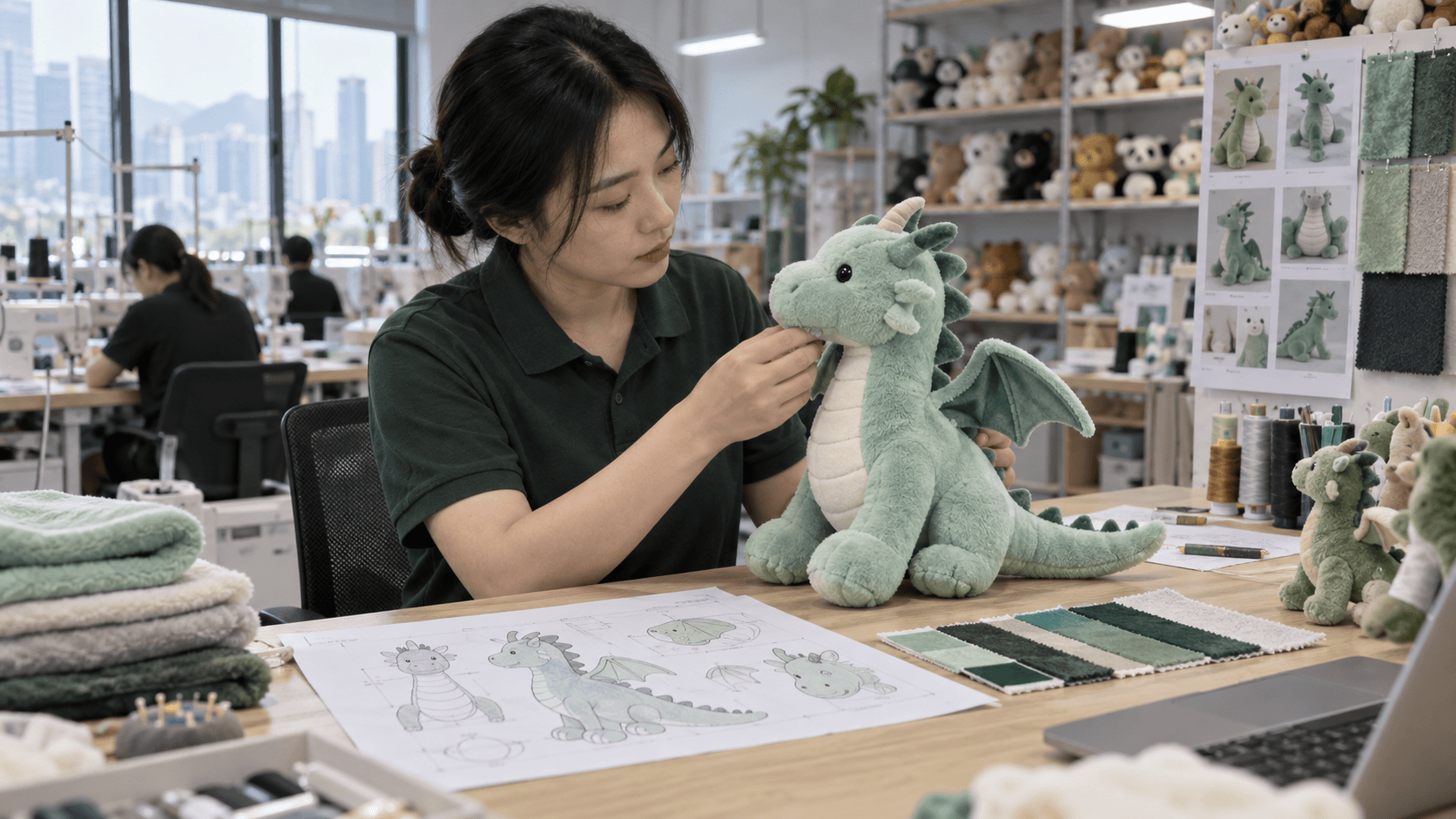
A custom plush toy is not finished when the artwork looks right on screen. The important work begins when a factory has to turn that artwork into pattern pieces, material choices, decoration files and a construction method that can be repeated in production. Sampling is where a buyer sees the difference between an appealing concept and a product that can be approved with confidence.
This guide maps a disciplined sampling and quality-control path for custom plush projects. It is not a substitute for product-specific testing, market compliance advice or a written specification. Instead, it helps procurement teams and brand owners ask the questions that keep design intent, production reality and shipment inspection connected.
1. Start with a product brief that separates priorities from preferences
A workable brief begins with the buyer’s intended product application. Is the item a retail character plush, a promotional giveaway, a collector piece, a baby-oriented gift or a seasonal display? The answer affects size, fabric, labels, packing, required documentation and the details that deserve the closest review.
Provide all useful views of the design, not only a front image. Side and back references, colour direction, logo files, desired dimensions, accessory details and packing references reduce ambiguity. Then identify which features are essential to brand recognition and which may be adjusted if the sample reveals a construction or material limitation.
2. How a drawing becomes a plush construction
Plush development translates a flat drawing into volume. Pattern makers decide where panels meet, how curves are formed, how limbs are attached, where filling is introduced and how facial features will sit on the finished surface. A good pattern is not simply one that recreates a silhouette in a photograph; it must also be stable and repeatable on a production route.
Material behaviour changes the result. Short plush, long pile, velboa, fleece-like fabrics and knitted textiles each reflect light, hide seams and accept embroidery differently. A facial line that is crisp on a smooth fabric may soften on a long-pile surface. Discuss these practical effects early so a revision is a considered design decision rather than a late surprise.
3. Review a sample with a repeatable checklist
Sample review is most effective when several people are not making uncoordinated comments at once. Nominate one person to consolidate feedback, label the sample version and keep the approved reference images together. Photograph the product from standard views and take close images of areas such as the face, appliqué edges, attachment points, labels and special trims.
Separate subjective feedback from measurable feedback. “The face feels less friendly” is useful, but should be paired with a visible request such as adjusting eye spacing, reducing muzzle height or changing embroidery density. Measurable comments help the sample team interpret the desired outcome and help the buyer verify the revised result.
- Overall silhouette and balance
- Key dimensions and placement of recognisable features
- Fabric hand feel, pile direction and colour consistency
- Embroidery, printing, appliqué and trim attachment
- Filling level, firmness and seam appearance
- Labels, warnings, packaging and carton markings
LET'S MAKE THE NEXT STEP CLEAR
Need a sample plan for your character or collection?
Share your artwork and product priorities. We will help identify the details to confirm before sampling starts.
Ask for Product Catalog →4. Document approval so production has one source of truth
Once the sample is approved, create a compact approval pack. It may include the approved sample version, measurements, fabric references, artwork files, colour notes, packing layout, label copy and the buyer’s acceptance priorities. The purpose is not paperwork for its own sake. It gives the sample team, production team, quality team and buyer the same agreed reference.
Changes after approval can still be necessary, especially if a material becomes unavailable or a customer requirement changes. Treat every change as a controlled revision: explain the reason, show the proposed effect, gain written approval and update the reference pack. This discipline reduces the chance that an earlier image or email is mistakenly treated as the current instruction.
5. Connect factory testing to the product’s real risks
Factory testing is most valuable when it responds to the product rather than appearing as a generic claim. A plush with an attached accessory may need focused attention on attachment security. A sound-producing or electronic product introduces a different set of questions. A design intended for young children, a travel retail channel or a specific country must be planned against applicable requirements by the responsible economic operator and qualified test partner.
Ask the factory how it records material confirmation, in-process observations and final checks. The answer should identify what is checked, when it is checked, what reference is used and how a non-conformity is handled. It is reasonable for a buyer to request records for agreed milestones, but photos should support—not replace—a clear inspection plan.
6. Use in-process checks to protect the approved sample
The bulk-production environment is different from a sample room. Materials are cut in volume, components move through several operations and several operators may be involved. That is why a first-piece or pre-production check is useful: it confirms the initial bulk result is aligned with the approved reference before the full order progresses.
In-process checks should concentrate on decisions that can be corrected before finishing and packing: panel orientation, embroidery position, filling, stitching quality, appliqué alignment and component attachment. If an issue appears, ask not only whether it can be repaired, but whether related pieces require review and how the corrective action will be confirmed.
7. Prepare shipment inspection before cartons are sealed
Shipment inspection works best when it is planned as part of the order, not scheduled after all decisions are final. Confirm the approved sample reference, inspection focus, packing configuration, carton marks, quantity and documentation needs. If independent inspection is required, agree access, timing and the responsible contact early enough to prevent a rushed handover.
A final inspection cannot recreate the development work that should have happened at sampling. Its role is to verify finished goods and packing against agreed requirements and identify exceptions before shipment. The clearer the approval pack and earlier checkpoints were, the more meaningful this final review becomes.
8. Manage a remote project without losing context
Overseas sourcing depends on written clarity. Use a single version of artwork, a shared list of open decisions and dated approval records. During time-sensitive stages, short visual updates with an explanation of what needs a decision are more valuable than large sets of unlabelled photographs.
Good communication does not mean a factory promises that every reference can be reproduced without change. It means the team flags trade-offs, presents a sample or material option and explains what requires buyer confirmation. This approach protects both the product and the relationship when a custom project becomes more complex than its original concept.
9. What buyers should take into the next project
The best sampling process becomes a reusable operating method. Keep the approval pack, inspection notes and final production photographs with the project record. On a repeat order, that history can help identify which features should stay fixed and which can be improved. It is also useful when a buyer, retailer or licensing partner asks how a product decision was made.
For a new design, start with the same discipline: a complete brief, a measurable sample review, a controlled approval reference and quality checkpoints tied to actual customer requirements. That is how custom plush development becomes a managed production process rather than a series of last-minute corrections.
For a closer look at our production environment, visit our Shenzhen plush factory, review our approach to quality checkpoints, or explore custom plush product directions. For market-specific guidance, consult the current information from the U.S. Consumer Product Safety Commission and the European Commission where relevant to your product.
Frequently asked questions
What should I check on a custom plush sample?
Review silhouette, dimensions, fabric, filling, decoration, seams, attachments, labels and packaging against the written brief. Capture revisions in one consolidated, version-controlled comment list.
What is a golden sample?
It is the approved physical and documented reference used to align bulk production and inspection. The records should identify accepted materials, measurements and critical appearance details.
Does final inspection replace in-process quality checks?
No. Final inspection verifies finished goods and packing, while in-process checks help identify and correct issues before they become widespread or are hidden by finishing and packing.
READY WHEN YOU ARE
Make your next plush sample easier to approve.
Bring your project reference, target market and packing requirements to the first conversation.
Contact Us →