
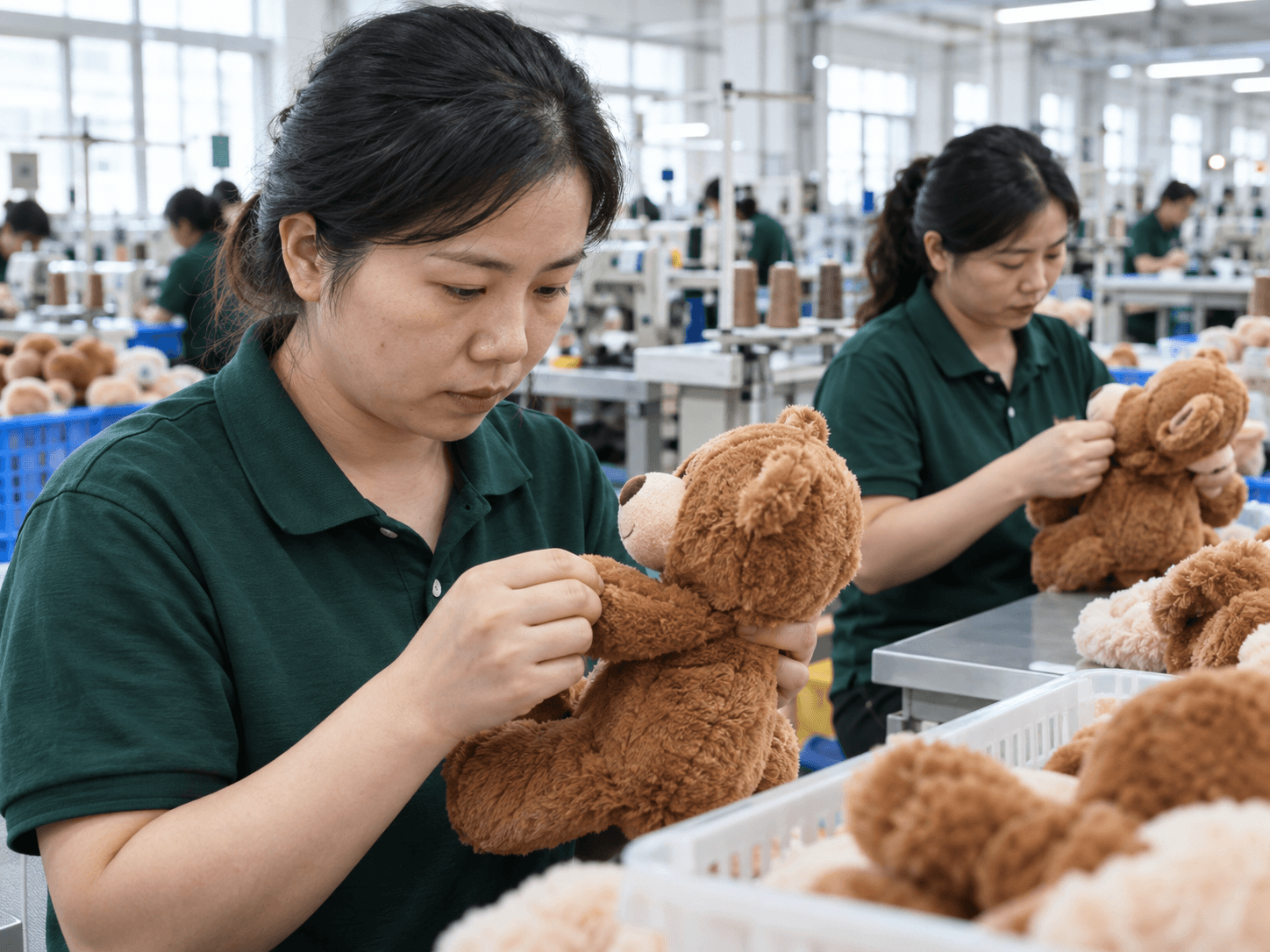
Safety and compliance for a plush toy should be planned before the product is sampled, not added after production is complete. A design’s intended age group, market, materials, components, labels, packaging and sales channel can all affect the requirements that apply. The responsible business should determine the applicable rules with appropriate professional and testing support; a factory can supply product information and help execute the agreed plan, but it cannot make a generic “compliant everywhere” claim for a custom product.
This article is a sourcing and preparation guide for businesses supplying children’s plush toys into the United States, European Union or Great Britain. It does not provide legal advice or replace the current requirements of regulators, accredited laboratories, importers, authorised representatives or retailers. Regulations and standards change, so confirm the latest market-specific position before placing goods on the market.
1. Start by identifying the product and responsible market role
The first question is whether the product is a toy and who will place it on the target market under their name or trademark. A plush intended primarily for children may fall within toy rules, while a decorative item, a pet product or a collector item can require a different analysis. Do not rely on a label or age mark alone to decide scope; use intended use, product presentation and local advice.
For US children’s toys, the Consumer Product Safety Commission explains that applicable requirements must be identified for the specific product and that children’s toys have testing and certification obligations. For the EU and Great Britain, manufacturers have responsibilities around safety assessment, conformity procedures, technical documentation and marking. The commercial agreement should make clear who owns the specification, testing plan, label approval and market documentation.
2. Build safety considerations into the plush design brief
A compliance-ready brief describes more than character appearance. Identify intended age grading, detachable or accessible components, magnets, sound modules, cords, filling materials, decorative trims, surface prints, packaging and warning requirements. Every feature can change the questions a test lab or quality team needs to ask.
For a basic textile plush, physical and mechanical risks may include seams, loose components and accessible small parts. Material and chemical considerations may involve fabrics, prints, coatings, labels and fillings. A product with batteries, electronics, a rattle, a fragrance or a rigid accessory requires additional product-specific review. Early design choices are usually easier to revise than late production changes.
3. Understand market frameworks without treating them as a checklist
In the United States, CPSC guidance states that the federal toy safety standard is incorporated by 16 C.F.R. part 1250 and that toys primarily intended for children aged 12 and under require applicable third-party testing and certification. The correct scope is product-specific: not every provision applies to every toy. Work with a CPSC-accepted laboratory and the responsible party to identify applicable requirements and the Children’s Product Certificate process.
In the EU, toys placed on the market must meet essential safety requirements and carry CE marking. The European Commission describes safety assessment across chemical, physical, mechanical, electrical, flammability, hygiene and radioactivity risks, with conformity assessment and technical documentation obligations. In Great Britain, the Toys (Safety) Regulations apply; current government guidance describes manufacturer duties and recognition of CE marking for relevant goods. These summaries are planning signals, not a substitute for a market-specific conformity assessment.
LET'S MAKE THE NEXT STEP CLEAR
Need to align your plush brief with a target market?
Send your intended market, age grading, product features and packaging requirements for an early production discussion.
Send Your Requirements →4. Create a document map before testing begins
Testing becomes more efficient when the lab, buyer and factory work from an agreed document set. Assemble current artwork, bill of materials, product dimensions, intended age grade, labels, warning text, packaging, factory details and a list of markets. Include earlier test reports only as supporting history; they may not cover a changed material, construction, age grade or market requirement.
The responsible market operator should confirm which documents are required, who signs them and how long they must be retained. Depending on market and product, this may include technical documentation, a safety assessment, test reports, declarations, certificates, traceability information and label records. Avoid copying a document from another product simply because it looks similar.
- Approved artwork and current bill of materials
- Age grading and intended use statement
- Material, component and label specifications
- Packaging artwork, warnings and traceability fields
- Factory testing records and shipment inspection plan
- Laboratory scope, reports and market-owner approval record
5. Use factory testing and inspection as preparation, not proof
Factory testing can help control variables that later affect formal testing and product consistency. The team can confirm materials received against approved references, look for construction issues at first-piece review and monitor known risk points during production. Attachment areas, decorative components, embroidery, seams and labels can be checked against the approved product and written instructions.
However, factory checks do not replace conformity assessment, third-party testing or certification that may be required for a product and market. Use factory records to support traceability and production control, then use the qualified lab and responsible market party to determine whether the finished product meets applicable requirements.
6. Plan labels, warnings and packaging with the plush
Labels and packaging are part of the information a customer, regulator, importer and warehouse may rely on. Plan enough space for required identifiers, manufacturer or importer information, warnings, markings and traceability information that apply to the target market. Ask for artwork proofs and review final language, placement and legibility before printing.
Do not assume a mark alone proves suitability. A CE or UKCA mark is attached to a wider conformity process, while US certification has its own structure. Where a retailer has additional packaging or testing requirements, treat them as customer requirements in the same controlled revision system as product changes. A late label change can delay packing and shipment handover.
7. Prepare for shipment inspection and release decisions
Before cartons are sealed, confirm production matches the approved version and that the documentation release path is known. Shipment inspection should examine finished product appearance, construction, labels, packing and carton marks against an agreed checklist. If independent inspection is required, arrange the date, sampling approach and corrective-action process before the final production window.
The decision to ship should be made by the appropriate responsible party using relevant quality, testing and documentation information. A factory can prepare records and support a buyer’s inspection, but the commercial and market release responsibility should remain explicit. This is especially important when goods are delivered to more than one country or retailer.
8. Work backward from market date, not factory finish date
A reliable compliance timeline includes design confirmation, sample development, test-sample preparation, laboratory lead time, review of results, label and packaging approval, bulk production, shipment inspection and freight. If a product fails a required assessment or a material changes, the timeline needs room for redesign, retesting or document updates.
During launch preparation, keep one owner for the compliance calendar and one current version of the product specification. That prevents production, packaging and test samples from moving forward on different assumptions. The earlier a market requirement is visible, the more options you have to solve it without undermining product or launch date.
9. Start the supplier conversation with the right facts
Tell the supplier where the product will be sold, who it is intended for, whether it contains special components and what documentation your buyer or retailer expects. Ask what information they need for a preliminary material and production review. A constructive response separates confirmed factory capabilities from points that require buyer, laboratory or legal confirmation.
For a custom plush project, safety planning is a shared workflow rather than a single certificate request. The factory needs a stable specification; the buyer needs product records and realistic production updates; the market owner needs the right assessment and documents. When these roles are visible from the start, compliance becomes part of product development instead of an obstacle at shipment.
For a closer look at our production environment, visit our Shenzhen plush factory, review our approach to quality checkpoints, or explore custom plush product directions. For market-specific guidance, consult the current information from the U.S. Consumer Product Safety Commission and the European Commission where relevant to your product.
Frequently asked questions
Can one test report cover every market?
Not automatically. Applicability depends on product, intended use, age grade, market, current rules and the responsible operator. Obtain market-specific advice from an appropriate testing and compliance partner.
When should toy safety testing be planned?
Plan it during development, once materials, construction, age grading, markets, labels and configuration are sufficiently defined. Late changes can affect the relevance of prior testing.
What can a plush factory provide for compliance preparation?
A factory can provide product and material information, sample support, production records, factory testing observations, labels and inspection preparation. The responsible market party must still determine requirements and approvals.
READY WHEN YOU ARE
Start your compliant plush project with a clearer brief.
Bring your product concept, destination market and customer requirements to the first review.
Get a Quote →